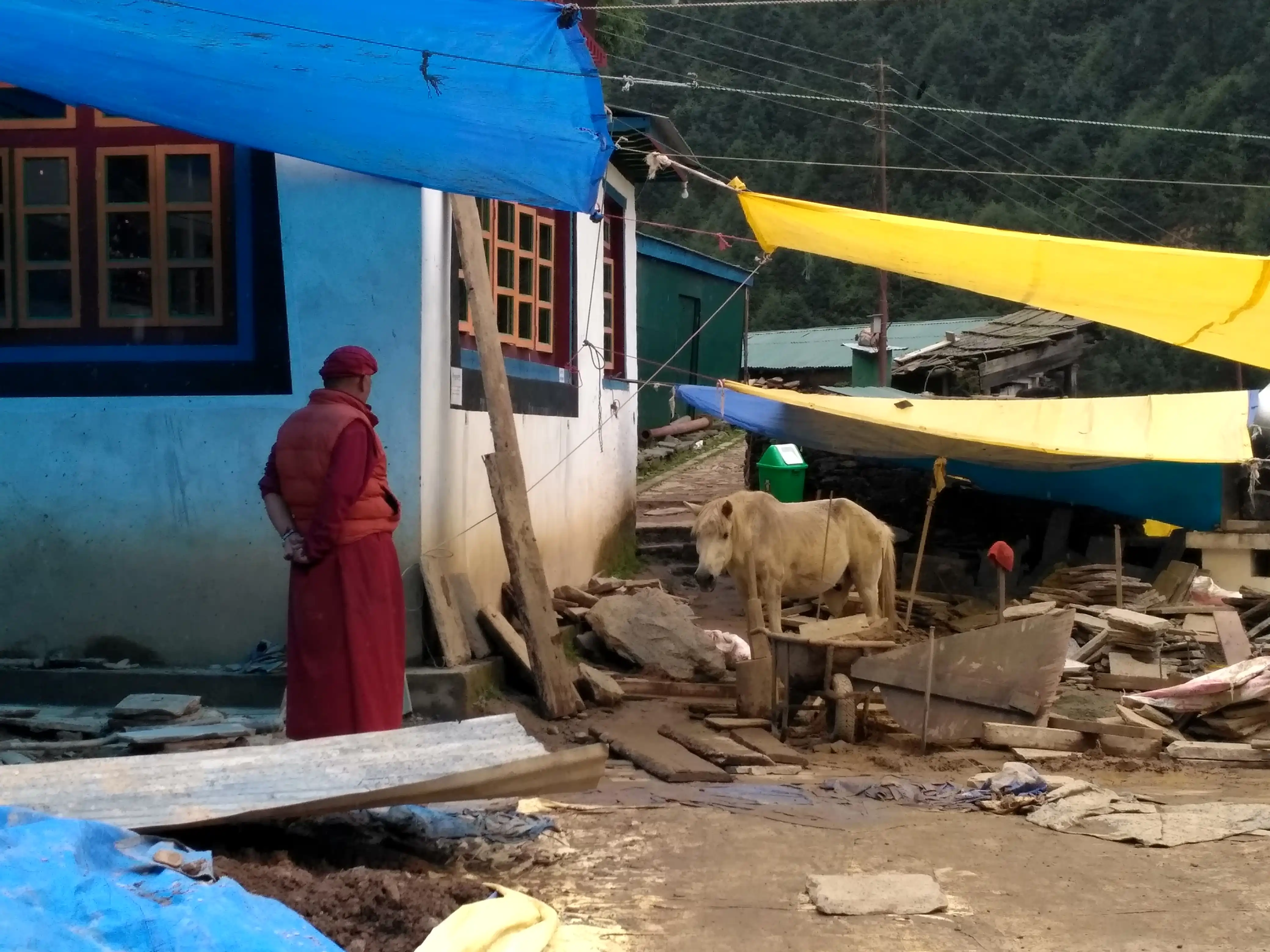
Rita Mancini – DREST (Italian Doctoral School Forfor Religious Studies), Department of Asian and North African Studies (DSAAM), Ca’ Foscari University of Venice (2023-present)
Recipient of a PhD scholarship funded by the UBI Research Center.
This doctoral project is situated at the intersection of cultural geography, religious studies, decolonial studies, and Critical Animal Geographies, adopting a feminist and antispeciesist perspective. The study questions the relationships between religion, environment, and non-human subjectivities, exploring how landscapes are co-constructed by human animals, non-human animals, cosmological forces, and spiritual presences.
Through a multispecies ethnography conducted in the Solukhumbu district (Nepal), the project analyzes the affective and ritual ecologies that take shape within Sherpa communities, historically linked to the Nyingma school of Himalayan Buddhism, which incorporates elements of the pre-Buddhist Bön and indigenous traditions. In these cosmologies, space is not a neutral container but a dynamic relational field in which territorial deities (yul-lha), sacred valleys (beyul), animals, spirits, and landscape elements participate in the production of meaning and the construction of moral order. Such places constitute epistemic spaces where environmental and ethical knowledge emerges through proximity and multispecies cohabitation.
By adopting a post-humanist ethnographic methodology, non-human animals are regarded as agentive subjects capable of actively influencing the social, ecological, and spiritual life of communities. This approach rejects the reduction of non-human animals to resources or symbolic devices, confining them to their economic value or semiotic and cultural significance; instead, it values relational forms of knowledge generated in the context of everyday life with affective and situated interactions.
Particular attention is paid to the ways in which environmental knowledge is site-specific and species-specific: inter- and intra-specific relationships do not develop in a neutral vacuum but are shaped by local knowledge, emotions, distributed agency, and spiritual presences. In turn, these relationships generate new orders of meaning, redefining what is considered living, sacred, and worthy of care.
The project problematizes the analytical categories often employed in the study of religions and indigenous cultures. Ontology – presented as a neutral or pluralist lens – may in fact conceal power relations and mask structural asymmetries. From this perspective, it is necessary to critically interrogate both hegemonic representations of Buddhism and academic narratives that risk reproducing epistemic, species-specific, and cultural hierarchies.
Within this framework, religion is not understood as a closed or immutable system but as a situated practice founded on multispecies relational proximity. Engaging with Buddhism from an antispeciesist and decolonial perspective entails recognizing both its ethical potentials, such as the principle of compassion toward all sentient beings, and its contradictions, particularly regarding material practices of animal exploitation. The Himalayan context, marked by tourism pressure and conservative rhetoric, demonstrates how religion can also become a tool for ecological and social ordering, often in tension with indigenous knowledge and resistance.
Ultimately, this research problematizes the very categories of “religion,”, “environment,”, and “species”, proposing to conceive Buddhist spirituality as part of a broader relational field, traversed by tensions, affections, and possibilities for ecological, cultural, and political regeneration.